
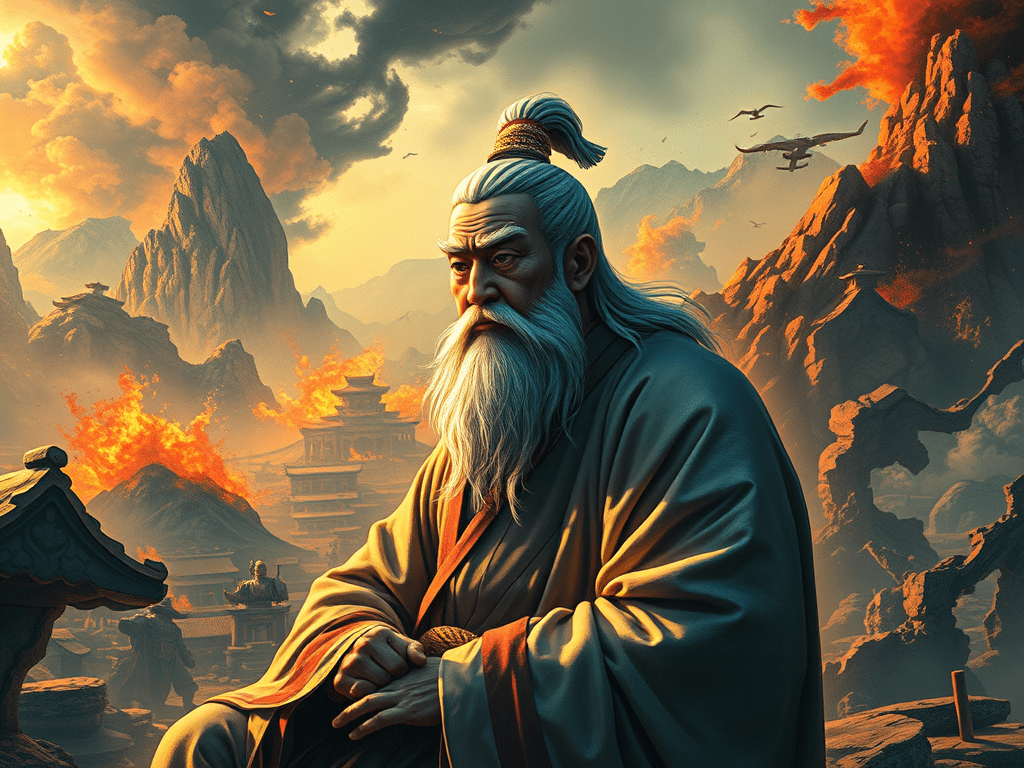
When we speak the name Confucius, we imagine an ancient sage wrapped in quiet dignity, offering pearls of wisdom to a troubled world. Yet even his name, like the era that produced him, is not quite what it seems.
The man history remembers as Confucius was born Kong Qiu—family name Kong, given name Qiu. The title K’ung-fu-tzu (or Kong Fuzi) simply meant “Master Kong.” It was a name of honor, not a birth name. Over centuries, Western tongues reshaped Kong Fuzi into Confucius, but behind the Latinized syllables stands a man deeply rooted in Chinese soil and suffering.
And suffering was everywhere.
A World Falling Apart
Confucius lived during the later Zhou Dynasty, an age when China was breaking apart. The once-powerful Zhou kings had lost control, and the land was fractured into rival states, each ruled by warlords who fought endlessly for power. Violence, betrayal, and corruption were common. Ordinary people bore the cost.
Out of this chaos emerged one of the greatest intellectual awakenings in human history.
Chinese thinkers began asking questions that still haunt us today:
- What makes a just society?
- What kind of person deserves to rule?
- How should humans live together?
Their answers became known as the “Hundred Schools” of thought—a flowering of competing philosophies. From this storm of ideas arose two traditions that would shape East Asia for more than two thousand years: Confucianism and Daoism.
Where Daoism sought harmony with the natural flow of the universe, Confucius sought harmony among people.
A Scholar Born of Hardship
Kong Qiu was born in the small state of Lu. His father, a minor official, died when he was still a boy, leaving the family in poverty. But hardship did not crush him—it sharpened him.
Confucius immersed himself in learning. He studied:
- religion
- ritual
- history
- and the ancient poetry of the Book of Songs
Through these texts, he came to admire the early kings of the Zhou Dynasty—rulers who governed not by fear but by virtue. To Confucius, they represented a lost golden age when morality, responsibility, and leadership were aligned.
He came to believe something radical for his time:
A society is only as just as the character of its leaders.
If the rulers of China’s warring states could become morally upright men, then the nation itself could be healed.
A Philosopher in Exile
With this belief burning inside him, Confucius did not retreat into a monastery or a mountain. He took his ideas into the world.
He traveled from state to state, offering his services as an adviser to rulers. He spoke of ethical leadership, proper conduct, and the responsibility of power.
But again and again, he was rejected.
The rulers of his day preferred manipulation to morality, force to fairness. Confucius discovered that wisdom is often unwelcome in corrupt courts.
Yet he did not walk alone.
Along his journeys, young men began to follow him—students drawn to his ideas, his discipline, and his vision of a better world. These disciples preserved his teachings, eventually compiling them into what we now call the Analects.
Through them, Kong Qiu became Confucius.
Why He Still Matters
Confucius did not create a religion in the modern sense. He created a moral framework—a way to build a society on responsibility, respect, and human dignity.
Many of the ideas that shape Western political and ethical thought today echo his philosophy:
- leadership as moral duty
- respect for elders
- education as social elevation
- the idea that personal character shapes public order
In a world still fractured by power, greed, and chaos, Confucius speaks across millennia, reminding us that no system can rise above the people who run it.
Griot Reflection
What did this awaken in me?
Confucius has always stirred something in me, but I had never truly known his story. Now I see him not as a distant sage, but as a man born into collapse, struggling to hold the world together with ideas alone. His philosophy mirrors so much of what the West claims to believe—yet it was born far from Europe, in a land wrestling with its own broken future.
That matters.
Because wisdom has never belonged to one civilization.

 The Timeless Griot
Leave a comment