
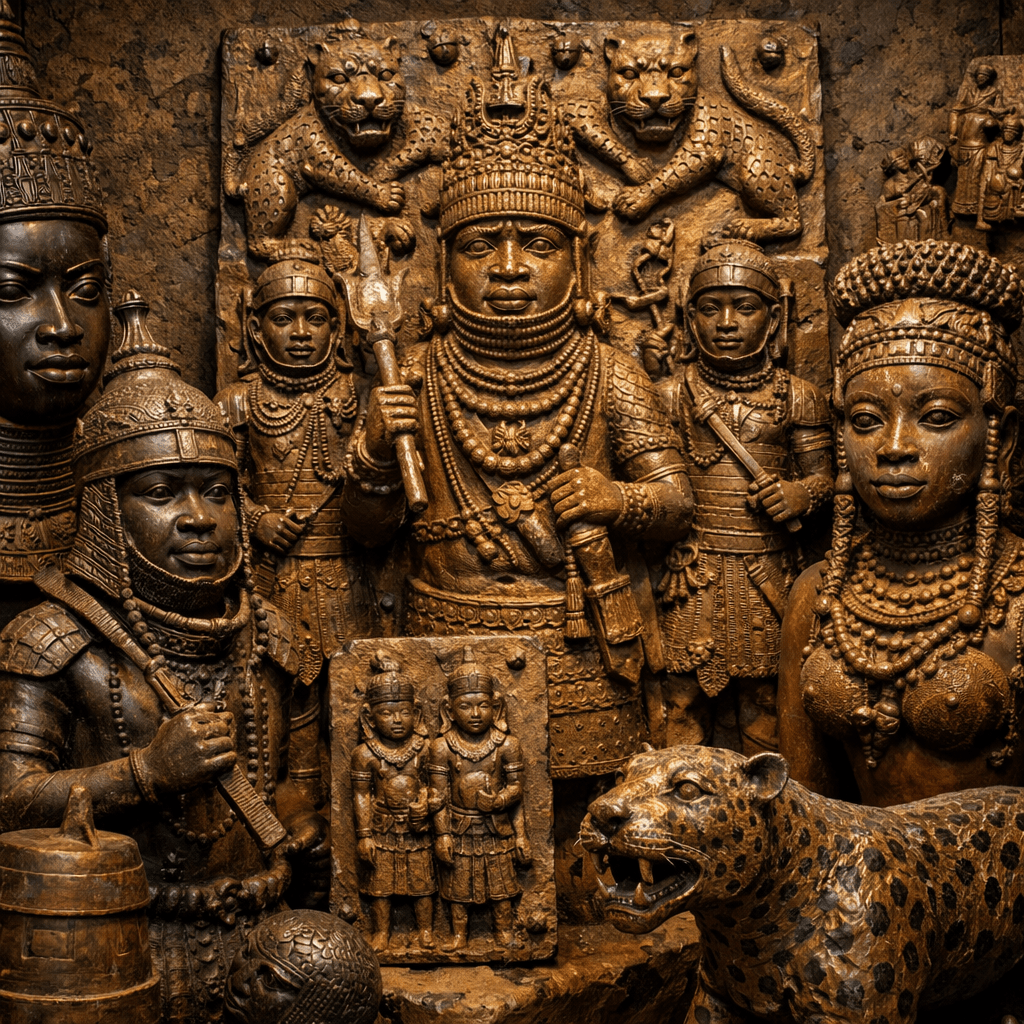
From the fifteenth century onward, the royal city of Benin – capital of the Kingdom of Benin in what is now southern Nigeria – produced some of the most sophisticated sculptural works in the world. Known collectively as the Benin Bronzes, these objects were created by the Edo people for the Kingdom of Benin, not as decorative curiosities, but as vessels of memory, authority, and continuity.
Despite their popular name, few of these works are actually bronze. Most are made of brass, an alloy whose acquisition and use were tightly regulated by the Oba, the divine king of Benin. This detail matters. It reveals a society with complex systems of resource control, artistic specialization, and symbolic language—features too often denied to African civilizations in colonial narratives.
Art in Service of the Sacred State
Benin brass works were not created for public consumption or commercial trade. They belonged to the royal court and were deeply embedded in ritual life. Sculptors—members of hereditary guilds—cast heads of kings, queens, warriors, courtiers, and deities using the cire perdue, or lost wax, method. This sophisticated technique, passed on through regional knowledge exchange with neighboring Yoruba cultures, allowed for astonishing detail: coral bead regalia, scarification marks, musculature, and expressions of authority frozen in metal.
Much of the brass was transformed into hundreds of plaques, each narrating scenes of courtly life, diplomacy, warfare, and ceremony. These plaques were nailed to wooden pillars throughout a vast royal palace built under Oba Ewuare, the formidable warrior king who reigned from around 1440 to 1480. Together, they formed a three-dimensional archive—a visual history encoded in metal.
This was art as governance. Art as memory. Art as cosmology.
1897: Violence Disguised as Collection
In 1897, British forces invaded and looted Benin City, bringing an abrupt end to the kingdom’s political independence. The attack was brutal and deliberate. Thousands of royal objects—brass plaques, commemorative heads, ivories, and ritual items—were seized, not as spoils of war acknowledged with shame, but as trophies reframed as ethnographic artifacts.
Within months, these objects appeared in museums, private collections, and auction houses across Europe and North America. They were studied, catalogued, and admired—often stripped of context—while the people to whom they belonged were silenced.
Today, the irony is impossible to ignore: works once cited as evidence that Africa had “no history” or “no high art” became foundational pieces in Western art history collections.
The Ongoing Question of Return
Many Western curators have long argued that African nations lack the resources to care for such artifacts. Yet this argument collapses under scrutiny. The Beninese monarchy still exists within Nigeria and has repeatedly called for the return of the bronzes—not only as cultural heritage, but as stolen property tied to living traditions.
In recent years, some institutions have begun the slow process of repatriation. Still, thousands of Benin works remain abroad, displayed far from the land, rituals, and descendants that gave them meaning.
The debate is not simply about conservation. It is about power, acknowledgment, and repair.
More Than Metal
The Benin Bronzes are not remarkable despite being African. They are remarkable because they are African—because they emerge from a civilization that understood art as an extension of statecraft, spirituality, and ancestral reverence.
To stand before a Benin brass head is to confront a truth long denied: Africa has always produced art of the highest order. The lie was never about absence. It was about refusal—to see, to credit, to remember.
Griot Reflection
What did this awaken in me?
Understanding that great art was being produced across the African continent dismantles a lie that still carries weight today. In my twenties, a former boss—who had emigrated from Germany—once told me, quite matter-of-factly, that Africa produced no art worthy of inclusion in The Art Book, a gift she had given me for Christmas.
The Benin Bronzes stand in direct opposition to that claim. Not quietly. Not politely. But undeniably.
They remind me that erasure often wears the mask of authority, and that reclaiming history is not about nostalgia—it is about truth. To know this history is to refuse smallness. To teach it is to restore dignity, not only to the past, but to ourselves.

 The Timeless Griot
Leave a comment