
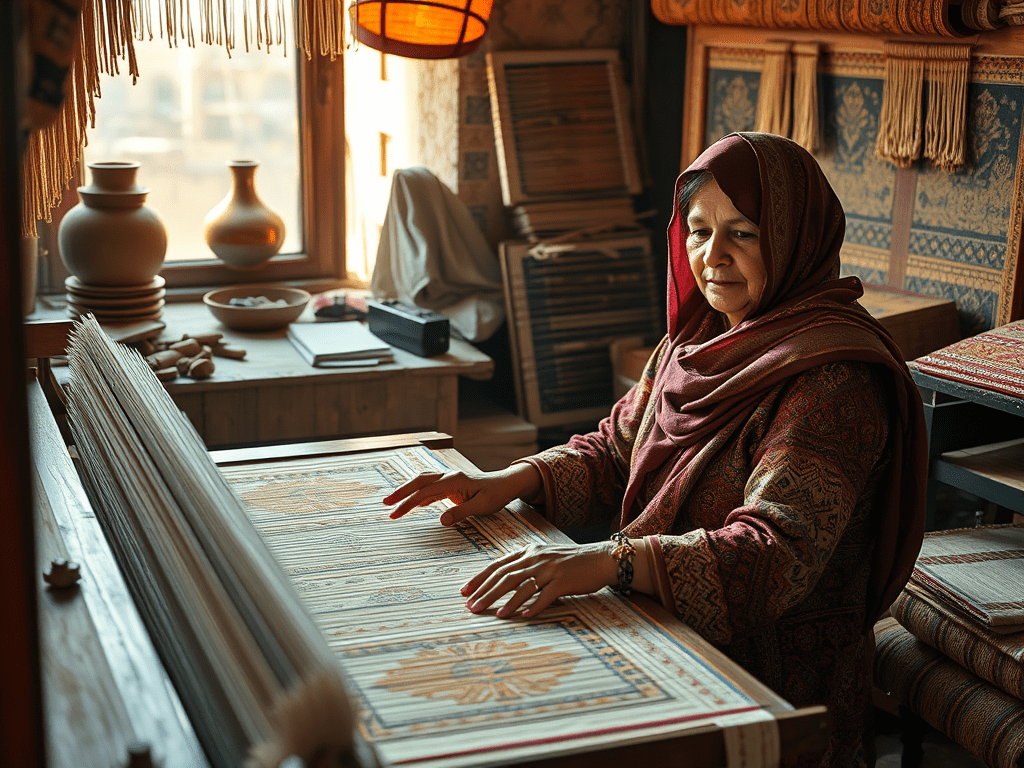
A Tale Woven in the Looms of Cairo
Cairo hums long before the sun fully lifts itself over the Mokattam Hills. In the narrow streets of al-Darb al-Ahmar, where shadows cling to stone like old memories, the city’s artisans begin their quiet rituals. Brass-workers heat their fires. Bookbinders lay out softened leather. And in a modest workshop tucked behind the Khan al-Khalili bazaar, a master weaver named Nafisa al-Sukar unrolls her thread.
Her loom is simple—polished wood worn smooth by generations of hands—but to Nafisa it is a living archive. Every thread carries a story; every knot an intention. Today, she is preparing to make a choice that generations of women before her were never permitted to make.
A City Woven From Many Worlds
By the late 14th century, Cairo glowed as one of the beating hearts of the medieval world. Merchants from Mali, scholars from Timbuktu, Venetian traders, Yemeni spice-sellers, and Nubian caravan men converged beneath its minarets. It was a city where knowledge traveled as fluidly as spice, and where stories took root in the seams of everyday life.
The weaving guilds were among Cairo’s quiet powers—guardians of patterns, symbols, and traditions that stretched back to pharaonic looms. Highly skilled, fiercely disciplined, and overwhelmingly male.
Except for Nafisa.
A Lineage Hidden in Pattern
Nafisa learned to weave from her grandmother, a Saidi woman who carried ancient Upper Egyptian motifs in her memory. These were designs often dismissed by city guilds, steeped as they were in their own prestige. Her grandmother taught Nafisa that each pattern meant something:
The zig-zag was water’s resilience.
The diamond was the eye that sees fate.
The broken line was a woman’s quiet rebellion.
But rebellion—quiet or not—had a cost.
When Nafisa’s grandmother died, leaving her with nothing but a loom and a head full of designs, Nafisa entered the guild under the guise of completing her late husband’s work. A fiction. But Cairo understood fictions; it ran on them as surely as it ran on trade.
The Commission
Word had spread that a powerful merchant from Damascus sought a tapestry unlike any woven in Cairo—something to commemorate his daughter, who was to marry into a family of scholars in Aleppo. A fusion of Egyptian mastery and Damascene elegance.
The guild master assigned the commission to Nafisa, believing she would merely copy the guild’s most approved patterns.
But when she began arranging her threads, something stirred inside her.
This tapestry would travel far beyond Cairo. It would hang in the home of a young woman stepping into a new life, navigating alliances, expectations, and the unspoken weight of family honor.
Nafisa understood that world well.
So she made her choice.
Threads of Defiance
She wove the damask roses.
She wove the geometric order of the Mamluk courts.
But between the lines—so subtly no guild master would detect it—she placed the patterns of her grandmother’s village.
A zig-zag at the tapestry’s border, barely noticeable.
A single diamond motif near the center, disguised as symmetry.
And near the base: a broken line.
To the untrained eye it was nothing. To a woman, however—especially a young bride—it said:
“You carry your lineage with you.
You are allowed to choose yourself.”
When the Guild Master Saw
When the tapestry was complete, the guild master inspected it with narrow eyes.
“A fine piece,” he said. “You have kept to our tradition.”
Nafisa bowed her head to hide her smile.
The merchant paid handsomely. The tapestry left Cairo. No one mentioned the hidden motifs again. Not openly.
But weeks later, a woman veiled in indigo arrived at Nafisa’s workshop. She lifted her face covering.
It was the merchant’s daughter.
“I saw it,” she whispered. “Your secret. My secret now.”
Nafisa nodded. Her threads had traveled far—carrying a message only women could decode.
A Legacy in the Loom
Centuries would pass. Cairo would rise, fall, and rise again. Dynasties would change, streets would shift, and merchants’ names would fade.
Yet somewhere in a private home in Aleppo, a tapestry still hung. Its colors dimmed by age, its silk softened by centuries of air.
But the patterns—the zig-zag, the diamond, the broken line—remained.
A reminder that history is shaped not only by kings, scholars, and merchants…
but by the quiet choices of women who wove their truths into the world, one thread at a time.

 The Timeless Griot
Leave a comment