
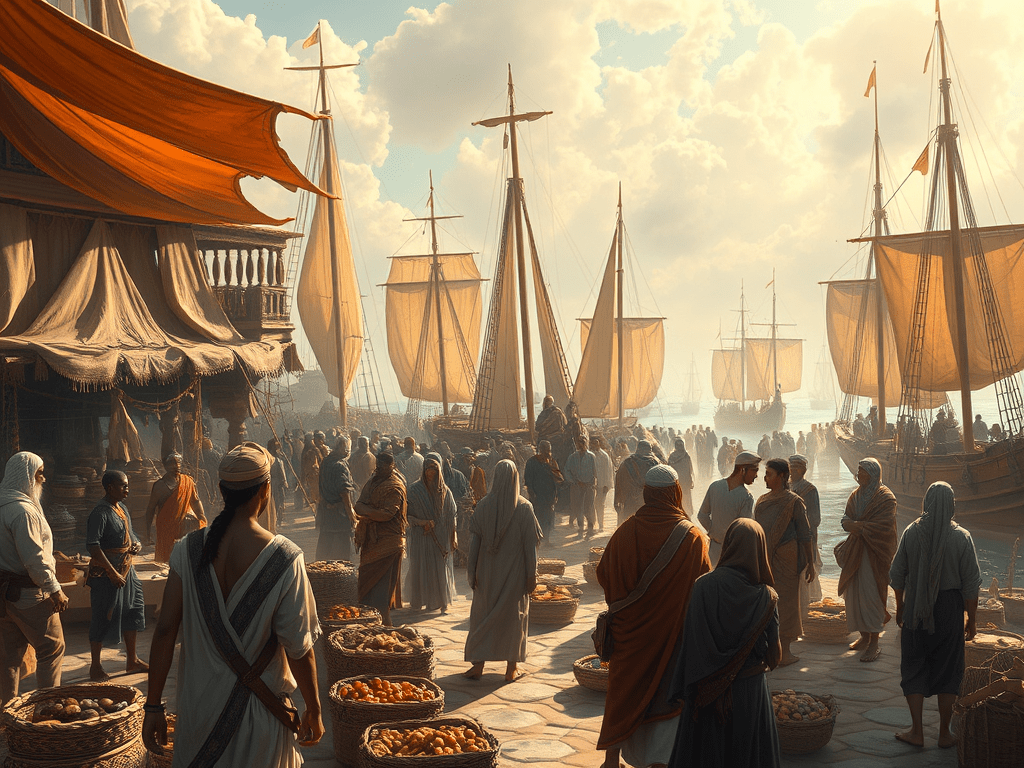
When we look back at the world between the 1300s and 1600s, it is tempting to imagine continents as isolated realms, each living out its own story behind natural walls. But the truth is far more fluid. The oceans that seem to divide us today once served as vast connectors—corridors of exchange, knowledge, faith, and family.
For our ancestors, the sea did not separate cultures.
It braided them together.
Where the Known World Melted Into the Horizon
In an age before printed atlases, maps were living things—whispered, memorized, sung in cadences tied to the stars. On the Swahili Coast, sailors learned the monsoon winds by heart, passing the timing of the kaskazi and kusi through generations. In West Africa, mariners studied river currents long before meeting the tides, using knowledge carried in proverbs, carved symbols, and community memory.
Far across the world, in the South China Sea and the Indian Ocean, Malay, Javanese, and Chinese shipwrights built vessels that dwarfed European crafts—ships with compartments, watertight bulkheads, and sails designed to drink in fickle winds. Their captains mastered routes that curved across half the globe without ever appearing on a sheet of parchment.
These were not just sailors but historians of the sky and sea, reading constellations the way a poet reads a metaphor.
And the sea carried their stories further than any caravan ever could.
Oceans as Arteries of Commerce and Culture
From the 1300s to early 1600s, maritime worlds hummed with exchange. Not the simple buying-and-selling we imagine today, but a full spectrum of cultural entanglement:
Along the East African Coast
Kilwa, Mombasa, Zanzibar, and Mogadishu were cosmopolitan centers where African, Arab, Persian, and Indian merchants mingled. You could walk a single marketplace and hear:
- Swahili,
- Gujarati,
- Arabic,
- Somali,
- and Portuguese,
often blended in the same conversation.
African gold from the interior traveled down river systems, onto dhows, and across the Indian Ocean to fuel the economies of Cairo, Gujarat, and the Red Sea.
Across the Arabian Sea and Indian Ocean
Merchants traced routes that had been active for over a thousand years:
- Cloves from the Banda Islands
- Pepper from Kerala
- Textiles from Gujarat
- Porcelain from Jingdezhen
- Ivory from East Africa
- And horses from Arabia
Each cargo carried not just goods, but beliefs, technologies, and family alliances.
In the Far East
The Ming voyages under Admiral Zheng He (1405–1433) connected East Africa to Southeast Asia and China in ways modern textbooks rarely dwell on. His fleets—some ships stretching over 400 feet—brought back envoys, giraffes, ambassadors, artisans, and untold literatures of human connection.
And Across the Atlantic
Long before Europe’s expansions altered the world, West Africans used deep knowledge of tides and winds to navigate rivers like the Gambia, Niger, and Senegal. Coastal communities such as the Wolof, Fula, and Mandinka shaped intricate networks of inland and maritime trade.
The Atlantic was not empty—it was a frontier of possibility, risk, and knowledge.
In these exchanges, the seas were not borders but arteries, pumping life between continents.
Women at the Water’s Edge
Mainstream history often ignores them, but women stood at the center of these maritime networks.
On the Swahili Coast, women owned stone houses and controlled inheritance—creating matrilineal lines that stabilized the wealth of port cities.
In West Africa’s coastal towns, women ran marketplaces, negotiated with foreign merchants, and served as cultural interpreters. Their linguistic gifts made trade possible, and their diplomacy prevented conflicts.
In Southeast Asia, women managed rice surpluses, oversaw household trading ventures, and maintained coastal farming systems that fed entire regions.
Even the smallest act—choosing which spices to mix, which cloth to weave, which songs to pass down—became part of the grand story of global connectivity.
A Maritime World Without Borders
Imagine walking through a 15th-century port:
Palm oil simmers in iron pots.
Children dart between piles of pepper sacks and cinnamon bundles.
Sailors with weathered skin laugh in five different languages.
A bead seller from Kilwa haggles with a trader from Gujarat over coral jewelry.
A Malay navigator explains wind patterns to a Yemeni sailor scratching notes into a wooden tablet.
Everyone here belongs to more than one place.
And the sea accepts them all.
The Winds That Bound the World
Where we see water, our ancestors saw pathways.
Monsoon winds connected Mombasa to Calicut.
The Kuroshio Current linked the Philippines to Japan.
The Mozambique Channel carried merchants safely north each season.
The Atlantic’s Canary Current whispered secrets to those who listened closely.
Sailors did not simply cross water—they crossed worldviews, exchanging:
- architecture styles
- mythologies
- culinary techniques
- musical scales
- healing practices
- and technologies like compasses, astrolabes, and sewn-plank boats
These became the building blocks of modern civilizations.
What the Sea Teaches Us
The sea, in all its vastness, teaches a simple truth:
We have always been connected.
Centuries before borders were drawn and policed, people moved with the rhythm of wind and tide, carrying with them the essence of who they were—and who they would become.
Today, the legacy of these ocean-crossers remains in:
- the Swahili words in Southeast Asian languages,
- the African rhythms in Brazilian samba and Caribbean drumming,
- the Indian spices woven into East African cuisine,
- the Islamic architectural influences stretching from Zanzibar to Java.
We live inside a world stitched together by water.
The Sea Without Borders Lives On
As The Timeless Griot, we gather these currents of history—stories of sailors and mothers, merchants and navigators, empires and everyday people whose lives intertwined across oceans.
They remind us that before nations drew lines, humanity followed waves.
And the waves never cared who belonged where.
They carried everyone willing to listen, to learn, and to travel.
If we look closely, we can still hear the ocean whisper:
“The world was always one.”

 The Timeless Griot
Leave a comment